

Library / Watch / Think Autism Melbourne 2026

Lived experience, Think Autism Melbourne 2026
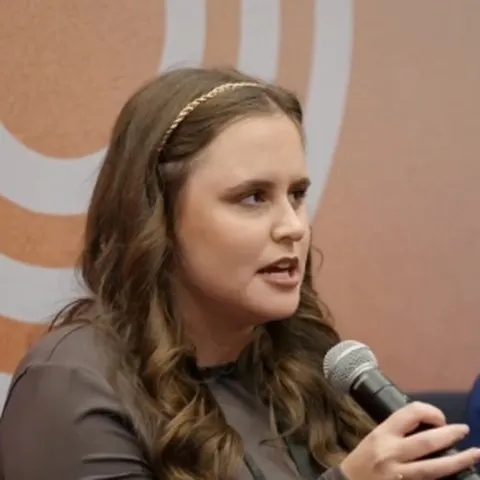
Siobhan Lamb on the six teachers she never had to mask for
In short
Taught as a child to rehearse small talk in a mirror, Dr Siobhan Lamb told Think Autism Melbourne that the teachers she had to mask in front of taught her nothing. She now teaches eye contact as a choice with a price.
Read it instead, 4 minutesThe transcript
The story
“I can name six people other than my parents that have got me to where I am. Six teachers.” Dr Siobhan Lamb made that count on stage at Think Autism Melbourne in May 2026, and then explained what the six had in common. They were the teachers she did not have to mask in front of. “Every other teacher that I had to mask in front of didn’t teach me a single thing,” she said. With the six, she could be herself and they looked after her.
She told the story in the middle of a disagreement. Another speaker on stage had just argued that while Lamb did not want her students to mask, many of them would need to learn how if they were going to succeed in the classrooms of most teachers. Lamb answered with her own childhood.
Sign in to keep reading, listening and watching.
Sign in with your email and everything in the Library is open to you: every story, every talk and every episode. It is free and it always will be. If you can, a donation helps keep it free for everyone.
Sources the story draws on
- Is social camouflaging associated with anxiety and depression in autistic adults? (opens in a new tab), Molecular Autism (Hull, Levy, Lai, Petrides, Baron-Cohen, Allison, Smith, Mandy), vol. 12, article 13
- How do adults and teens with self-declared Autism Spectrum Disorder experience eye contact? A qualitative analysis of first-hand accounts (opens in a new tab), PLoS ONE 12(11): e0188446 (Trevisan, Roberts, Lin, Birmingham)
More from Think Autism Melbourne 2026
All 48-
 3 minutes 7 seconds, captioned Autistic burnout is different from tiredness, and a holiday does not fix it Anita Aherne, Hannah Badenhop and 1 more Opening a Think Autism Melbourne panel in 2026, Anita Aherne said workplaces still had no clear definition of autistic burnout. The panellists described what it is and why rest alone does not end it.
- 7 minutes 16 seconds, captioned Employers avoid naming autistic burnout because naming it creates liability Shamus Hart, Kathleen McCarthy At Think Autism Melbourne in 2026, Shamus Hart argued that risk averse organisations keep autistic burnout out of policy on purpose. Kathleen McCarthy described how risk systems turn it into a personal choice.
- 6 minutes 35 seconds, captioned Workplaces can supply cupcakes for inclusion but cannot change the lights Shamus Hart, Hannah Badenhop At Think Autism Melbourne in 2026, Shamus Hart called much workplace inclusion performative and said doing nothing still carries moral weight. Hannah Badenhop said neurodiversity is missing from many diversity policies.
- 7 minutes 10 seconds, captioned Kathleen McCarthy was shut out of talks on her own workplace accommodations Kathleen McCarthy At Think Autism Melbourne in 2026, Kathleen McCarthy said her employer excluded her from discussions about her burnout because she had a vested interest. She argued that such a policy is worthless.
- 6 minutes 6 seconds, captioned Prevent autistic burnout by design, and ask the person what would help Shamus Hart At Think Autism Melbourne in 2026, a panel on autistic burnout heard that it largely disappears when supports are built in. Hannah Badenhop set out what that means for workplace policy, and the panel heard the case for asking the person in burnout.
- 10 minutes 30 seconds, captioned John Munro traced how an autistic student’s school day uses up working memory Professor John Munro At Think Autism Melbourne in 2026, Professor John Munro described how a classroom’s unspoken assumptions drain an autistic student’s thinking space as the day goes on, and said the system’s policies do not equip teachers to see it.