

Library / Watch / Autistic Pride Day Symposium 2024

Community voice, Autistic Pride Day Symposium 2024
Especially hard to find if not a Caucasian cisgender boy, an activist said
In short
In the last round of the 2024 Sydney symposium, participants spoke about who gets recognised, from masked adults to late diagnosed sisters, and what a full room changed for them.
Read it instead, 5 minutesThe transcript
The story
Near the end of the 2024 Autistic Pride Day Symposium in Sydney, a participant who described themselves as an activist said the most striking thing about the day was the number of people in the room. They had never seen so many autistic people together before. Autistic people, they said, are part of a minority community and are hard to find, because so many mask. “Especially if you’re not a Caucasian cisgender boy. It’s so hard to find you guys,” they said.
Others in the final round described neurodivergence going unrecognised for years, and the different routes by which people had come to be seen.
Sign in to keep reading, listening and watching.
Sign in with your email and everything in the Library is open to you: every story, every talk and every episode. It is free and it always will be. If you can, a donation helps keep it free for everyone.
Sources the story draws on
- Estimate of autism's sex ratio reaches new low (opens in a new tab), Spectrum (now The Transmitter, Simons Foundation), Sarah DeWeerdt, reporting Loomes et al. in the Journal of the American Academy of Child and Adolescent Psychiatry
- Autism in Australia, 2022 (opens in a new tab), Australian Bureau of Statistics (Survey of Disability, Ageing and Carers 2022)
- Patterns in reporting and participant inclusion related to race and ethnicity in autism intervention literature: Data from a large-scale systematic review of evidence-based practices (opens in a new tab), Autism (SAGE), Steinbrenner, McIntyre, Rentschler and colleagues; record on the Frank Porter Graham Child Development Institute, University of North Carolina at Chapel Hill
More from Autistic Pride Day Symposium 2024
All 94-
 6 minutes 30 seconds, captioned Sharon Zivkovic said autistic expectations had risen and called it a social movement Dr Sharon Zivkovic, Christina Chun Opening the closing session of the 2024 Sydney symposium, Dr Sharon Zivkovic said the bar for future autistic lives had been raised in two years. Participants then described what the two days had meant to them.
-
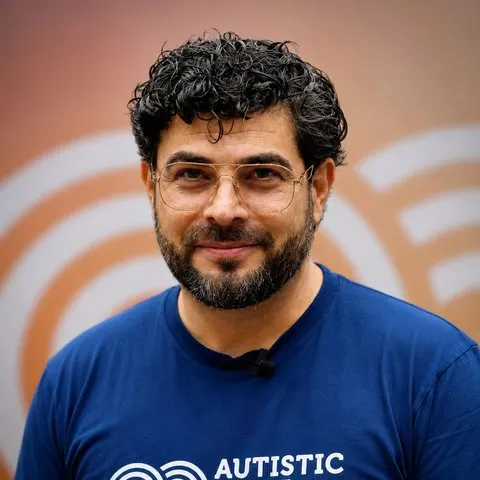 5 minutes 55 seconds, captioned Autistic led does not mean autistic only, an AV panellist told Sydney Kyriakos Gold A founder diagnosed with ADHD three weeks earlier challenged the symposium’s red flag test for programs that are not autistic led. A panellist from Aspergers Victoria replied that the leadership did not have to be one person.
- 1 minute 58 seconds, captioned Minds at Play, a contract critique and growth built from special interests Dwayne Fernandes At the Sydney symposium in 2024, Dwayne Fernandes of Minds at Play described an autistic employee whose critique of a contract fixed a problem for the business. A panellist explained using a game to start the conversation.
- 9 minutes 1 second, captioned Sleep, preparation and support workers, the hidden cost of attending an autism event Autistic Pride Day Symposium 2024 In the closing session of the 2024 Sydney symposium, a first time attendee asked for more talk about struggle. The replies described how much effort it takes to be in the room at all.
- 2 minutes 48 seconds, captioned Kyriakos Gold on unmasking at 48 and being told he does not look autistic enough Kyriakos Gold In the closing session of the 2024 Sydney symposium, Kyriakos Gold described the daily work of suppressing sensory pain, what unmasking had done to his composure, and the comments that called him a fraud.
- 3 minutes 45 seconds, captioned Tourette’s, a childhood stroke and why one panellist chose to be the bridge Autistic Pride Day Symposium 2024 In the closing session of the 2024 Sydney symposium, a panellist from Aspergers Victoria described conditions that complicate each other’s treatment, a childhood without support, and accepting a harder road for others.